Consider These Pros and Cons before Launching Your Shopify Website
Do you want to build your own eCommerce store with a powerful platform like Shopify? Your preference is credible, as it is already an industry leader among e-commerce builder platforms and highly popular for its exceptional ease of use and flexibility. But like every other platform. Pros of using Shopify Unquestionably, Shopify as an eCommerce […]
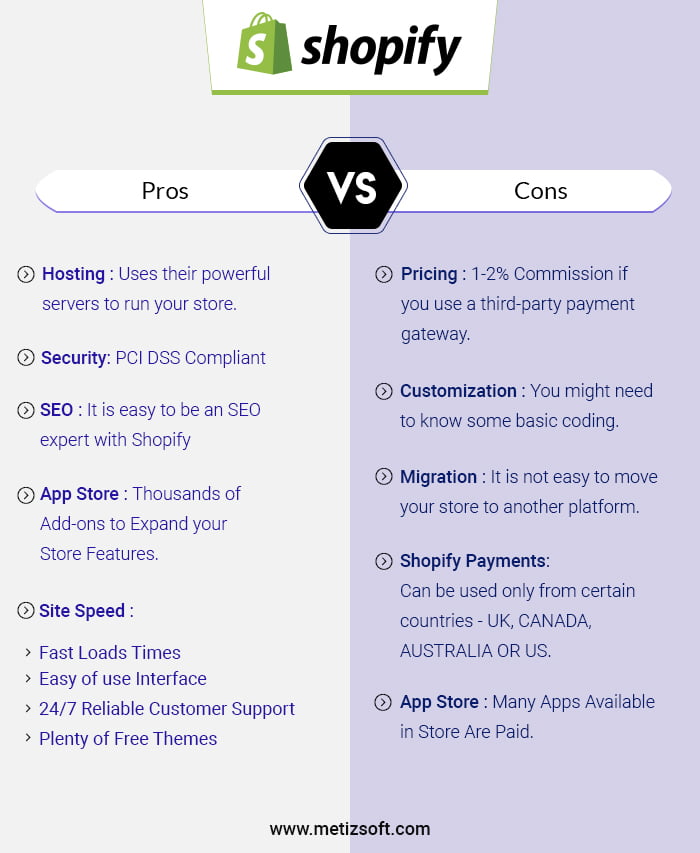
Do you want to build your own eCommerce store with a powerful platform like Shopify? Your preference is credible, as it is already an industry leader among e-commerce builder platforms and highly popular for its exceptional ease of use and flexibility. But like every other platform.
Pros of using Shopify
Unquestionably, Shopify as an eCommerce platform is popular because of a long list of pros. Let us have a look at a few of them.
- Ready to deliver
Shopify is ready to deliver a turnkey solution that lets you build your website quickly and easily. Sign up, and you are ready to design and build your online store. The fast-paced setup enables you to sell your products as quickly as possible.
- Exclusive built-in features
There is an array of powerful built-in features this platform offers. With these features, most of your technical issues are solved and you get most of the functionalities one normally needs with an online store.
- Hosting service
When building your store with Shopify you can also get their hosting service equipped with powerful servers. This also takes away the entire trouble of handling your server and troubleshooting to run it.
- Exceptional security
Shopify, fully PCI DSS compliant, provides optimal security for credit and debit card transactions in accordance with industry standards. Moreover, the store includes a free SSL certificate to encrypt all your business-sensitive data.
- SEO advantages
Shopify offers foolproof features for your eCommerce site to target search page ranks. Besides allowing adding metadata and tags it allows integrating analytics to evaluate your SEO practices and make them better over time.
- Easy UI
Shopify offers an easy-to-use UI equipped with great design features. Shopify UI allows everyone to find their way while browsing the store. While offering a visually appealing UI, a Shopify store makes it extremely easy to purchase products.
- Multitude of add-ons
Shopify also offers a great App Store featuring a multitude of add-ons allowing you to expand the site features. Many are free, while a few require a one-time or monthly subscription.
- Customer support
Shopify also offers around-the-clock customer support to help you resolve technical issues and answer your questions.
- Responsive web design
Shopify’s eCommerce design is fully mobile-friendly and enables users to browse and make purchases through a responsive UI.
- A lot of customization options
Shopify also offers a range of customization options and numerous free themes. They offer their preferred look and feel.
Cons of using Shopify
In spite of so much to offer Shopify does not come without an array of drawbacks as well. From the point of view of establishing an e-commerce business, Shopify also comes packed with a few disadvantages.
- Shopify is not free
Yes, like many other free and self-hosted e-commerce platforms, Shopify is not free. In contrast, you have strong options for building e-commerce stores, such as Magento, Zen Cart, and WooCommerce. If you are a programmer with some years of experience in building a web interface, you can go with these free and self-hosted options to build your own custom-designed web store. Obviously, for security certificates, payment gateways, and many other features, you need to pay for them, while with Shopify, all these features just come for free.
- Limitations with customization
Though Shopify offers a range of powerful themes, they can be problematic to customize. There is also a learning curve, as Shopify is built on its own language, Liquid. While you can use other programming languages, Shopify imposes certain limitations.
- Very basic marketing tools
There is another central accusation against Shopify: its very basic, elementary nature as a marketing tool. Though many think saying this undermines the platform’s capabilities, it depends on the type of e-commerce store you need to build with Shopify. There is a gamut of tools available for free, and you can always go to the App Store for additional tools you need.
- Not organized in the way other platforms are
Shopify offers a differently organized interface with many interesting options for choosing preferred category names. Many of these category names can add to user confusion, making navigation on the website more difficult. Such unconventional category names and a poor user experience add to the learning curve and usability.
- Migration difficulty
It is not uncommon for Shopify users to migrate to other platforms. But many users complain that deciding on such a switch can make migration more difficult in multiple ways. You may also lose some of your stored data during the Shopify migration. You have only the CSV export of your site left. This is a persistent issue with many eCommerce platforms, including Shopify.
Final Verdict
Pros and Cons of Shopify: In the final analysis, it’s a platform that works well for most people looking to build an online business presence. The best thing about Shopify is that it is versatile and flexible enough to go with a variety of preferences, niches, and needs. Most notably, in addition to paying a subscription fee, you do not need to pay for any other items required to set up your store. A Shopify store can be set up in under a quarter of an hour, with all features and design attributes intact.
Lastly, Shopify also offers one of the best pricing plans in the market. Even if you have chosen the basic one with the lowest subscription fee, you can always go to the app store and access what you need.

Leave a Reply