Universal Commerce Protocol (UCP) for Shopify Plus: What Google Launched, How It Works, and Why It Matters
Summary Universal Commerce Protocol (UCP) is an open standard launched by Google in January 2026 that allows AI agents to make actual ecommerce happen, discovery, adding to cart, or even checking out and post-purchase using a common commerce language. UCP for Shopify Plus storefronts is a new commerce layer that enables customers to purchase products […]
Summary
Universal Commerce Protocol (UCP) is an open standard launched by Google in January 2026 that allows AI agents to make actual ecommerce happen, discovery, adding to cart, or even checking out and post-purchase using a common commerce language. UCP for Shopify Plus storefronts is a new commerce layer that enables customers to purchase products directly within AI-powered experiences such as Google AI Mode and Gemini.
Introduction
The way people shop online is changing quickly. On January 11, 2026, Google quietly announced a new era in ecommerce. It’s not a new app, a marketplace, or another checkout button. It’s a new language for commerce, called the Universal Commerce Protocol, designed for a modern eCommerce world where AI not only recommends products but also helps you buy them.
And it’s not a new or untested method that’s far away; it’s valuable knowledge available for Shopify Plus merchants. It offers an early glimpse into how enterprise commerce will work within AI-led experiences, where discovery, comparison, and checkout occur in one conversation rather than across 10 browser tabs.
Let’s unpack what Universal Commerce Protocol (UCP) really is, how it works, and what it means for Shopify Plus brands preparing for the next generation of ecommerce.
What is Universal Commerce Protocol (UCP)?
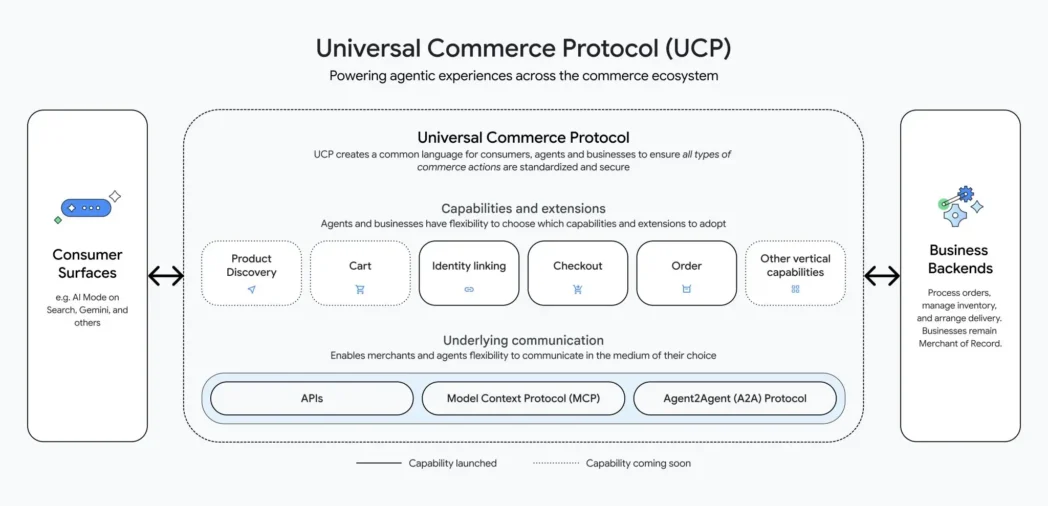
Universal Commerce Protocol (UCP) is a public and freely available standard that sets up a shared way of communicating about commerce between:
- AI tools or customer interfaces (like Google’s AI Mode and Gemini)
- Sellers and online shopping platforms (like Shopify)
- Payment services
- Retail systems that handle orders, delivery, and what happens after a purchase
In plain terms, UCP is a shared protocol that helps an AI assistant reliably perform commerce tasks like building carts, applying discounts, quoting shipping and taxes, initiating checkout, and managing orders, without every platform needing to build custom integrations for every store.
Why Google and Shopify built UCP?
Today’s commerce integrations are fragmented. Every new shopping surface, search, social, marketplace, or chat typically requires bespoke work: unique APIs, unique checkout flows, and unique post-purchase hooks.
UCP’s purpose is to reduce that complexity by defining:
- A standard suite of commerce modules (so agents know what to ask for and merchants know what to send)
- A “capability negotiation model” (so that, for example, an agent can know what a vendor supports)
- A safe way for transactions and payments (so users can purchase within AI experiences)
Shopify’s framing is particularly to the point. It aims to integrate merchants into every AI conversation without requiring them to rewrite commerce logic for any new AI channel that emerges. That’s why UCP Shopify integration is a big deal. It’s all about commerce being embedded in every smart interface.
What UCP Includes or What it Carries?
UCP is designed around real commerce complexity, not toy demos. Official materials emphasize that it supports core and advanced needs, such as:
- Accurate pricing
- Discounts and promotions
- Loyalty considerations
- Subscriptions
- Fulfillment choices and terms
- Extensibility in the form of capability extension for edge cases and custom rules
Google’s UCP documentation shows UCP on Google with usable building blocks such as:
- Business profile publishing
- Payment pages (native + optional embedded)
- Payment processing (including Google Pay processor)
- Identity linking (optional)
- Order lifecycle management
- Hazard Signals( for fraud and security considerations)
That list is significant for Shopify Plus teams, as it shows that UCP isn’t all about discovery. Google is building for end-to-end transactions and AI-powered checkout.
How UCP Works: Step-by-Step Process?
Consider the Google Universal Commerce Protocol as a handshake-and-workflow approach, enabling an AI agent to move from “help me find the right product” to “place the order” using a standard protocol.
1. Discovery and Intent
A shopper starts on an AI platform, like Google’s AI Mode or Gemini. The system collects the shopper’s preferences and intentions, including size, budget, delivery time, and intended use. Next, it needs to find a streamlined way to ask stores about their products, inventory, and more. Google UCP then serves as a standard format for these transactions.
2. Ability to Negotiate
Not every store offers all types of services (such as subscriptions, delivery policies, and payment options). UCP is designed so that stores can share what they can do, and helpers can adjust their plans accordingly, reducing payment issues.
3. Cart + Pricing Accuracy
Commerce is going on all around us. Buyers want to know the exact amount they need to pay, including the base price, taxes, shipping charges, discounts, and any terms and conditions. UCP focuses on these key details, including discounts and conditions that determine whether a sale occurs.
4. Checkout (Native or Embedded)
Google’s UCP guidelines illustrate a native checkout flow, with the ability to embed a checkout (where a merchant experience needs to be surfaced differently) as an optional feature.
This is important because it is not “AI recommends, and then sends a link.” It’s “AI helps you buy here.”
5. Payment Handling
A Google Pay handler is also mentioned in the implementation docs. UCP is further stated to be consistent with an agentic payment mode.
6. Order Lifecycle + Post-purchase Support
Purchases don’t end at checkout. UCP is designed to facilitate the entire journey, from confirmations and status updates, to post-purchase experiences, to enable agents support a customer beyond only during a purchase.
What Changes for Shopify Plus Merchants
Shopify Plus brands typically prioritize three things above all else: control, conversion, and complexity. Fortunately, UCP touches all three.
1. New Buying Surfaces: At the Checkout, and Inside the Mind
Google makes it clear that with UCP, you can make buying actions in Google AI Mode and Gemini via direct buys.
For Shopify Plus brands, it could open a new avenue whereby:
- There is discovery inside AI search and chat
- Product selection is guided conversationally
- Checkout is not a customer jump on 10 pages or above
The Verge’s coverage also ties the announcement to “buy” buttons and a broader push to complete purchases within Google’s AI experiences.
2. Less Integration Chaos and Faster Channel Expansion
In the previous setup, each new “commerce surface” needed a separate integration project. The main idea behind Google’s UCP for Shopify Plus is to eliminate the hassle of repeating the same integration by providing a single, consistent way to communicate across the ecosystem.
For teams using Shopify Plus, it’s not just about making things easier; it’s about making faster decisions:
- Testing new AI channels is faster.
- Fewer custom designs are needed for each channel.
- There’s a lower risk of fragile single-use connectors breaking.
3. Better Handling of Enterprise Realities
Shopify UCP page focuses on tangible drivers of enterprise conversion, discounts, loyalty, subscriptions, fulfillment, and non-negotiables for Shopify Plus brands.
If UCP is successful, it will enable the delivery of advanced AI features without making them simpler or less interesting.
4. A Change in How SEO and Shopping Discovery Function
This change is small but very important. If people start shopping through conversations with AI, finding products might rely less on the usual “ten blue links” and more on:
- Well-organized product information
- Signs of trustworthy sellers
- Correct pricing
- Clear information on how orders are fulfilled
- Compelling product narratives that AI can put together
This is the real future of eCommerce with Shopify Plus, where organization and clarity improve how things are seen.
5. High-Quality Standards and Safety
UCP is not just about speed and ease; it also focuses on risk management and regulatory compliance in a business environment. It has features for:
- Safe, token-based payments
- Keeping track of the main seller
- Proof of consent and traceable records
There’s a lot at stake for Shopify Plus brands here. Enterprise commerce teams are obligated to comply with stringent security, legal, and regulatory regimes. Any new purchasing channel would need to meet internal risk, privacy, and governance needs.
AI-led commerce rewards brands with clean data, resilient checkout logic, and scalable architecture. If you run or plan to build a Shopify Plus store, this is worth paying attention to. Now is the time to reassess your foundation.
Explore how Metizsoft helps Shopify Plus brands build AI-ready commerce ecosystems.
What Merchants Should Do Next: Practical Actions?
Even if your company isn’t going to start using UCP right away, it’s clear what’s coming next. Here’s the clever preparation list for Shopify Plus groups:
- Audit the quality of product data: important titles, variants, attributes, conditional shipping policies, and inconsistent return terms and pricing are more motivating in AI-driven journeys.
- Use discount and eligibility logic: UCP is designed to handle your discounts, terms, etc., ensuring your promotions are clean and not reliant on fragile front-end hacks.
- Map out your checkout needs: If you depend on subscriptions, special fulfillment, identity linking, or custom payment flows, account for that. The UCP capability model is there for a reason.
- Follow Google’s UCP onboarding path: This will be a major milestone if your business relies on Google for growth.
Potential Risks and Realities to Watch
No new protocol will be perfect right from the start. Checking, improving, and making changes will continue, and eventually you will get to try something different. While you wait, here are a few specific things to pay attention to:
- Adoption rates by platform and retailer: Open standards succeed when everyone agrees to support them.
- Customer trust: Using chat for shopping will only be successful if it feels safe and clear to the user.
- Attribution and measurement: Brands want a clear read on what drove the sale in an AI-mediated journey.
Edge-case handling: This is your job. As UCP faces various challenges, its growth strategy will be tested over time.
FAQs
1. How does UCP influence Shopify Plus sellers?
UCP enables Shopify Plus businesses to buy things using smart tools such as Google AI Mode. It opens new ways to buy, makes joining multiple systems easier, and brings advanced checkout options to chat-based shopping.
2. Can consumers purchase products directly in the AI chat?
Yes. UCP is built so that AI agents can execute actual purchases, including adding items to the cart, summing totals, applying discounts, and entering the checkout process, without requiring users ever to leave the AI interface.
3. Do Shopify merchants need to change anything now?
Not immediately. But in the interim, brands should begin tightening product data quality, pricing accuracy, and checkout architecture to be prepared for when AI-led commerce takes off.
4. Will Universal Commerce Protocol replace ecommerce sites?
No. UCP doesn’t replace storefronts. It adds a new commerce layer. Websites remain important for brand experience, while AI creates yet another high-intent entry point.
5. Does UCP only work with Google, or is it available across other platforms as well?
UCP is an open standard. Although Google is the first to release, it’s built to be integrated with all AI platforms so that Shopify Plus merchants can acquire customers across multiple ecosystems.
6. Does UCP hand over power to Google through merchant data or customer relationships?
No, merchants own their records. Shopify Plus brands own their pricing, customer data, fulfillment, and post-purchase experience. UCP only enables interaction.
The Real Takeaway
Google’s Universal Commerce Protocol, or UCP, is a new system that uses a common shopping language. It allows AI agents to seamlessly transition from product recommendations to purchase completion, from item discovery to payment, and even after the sale. This means everything works together without confusion or chaos.
For Shopify Plus merchants, this is but the start of what could be a new distribution layer: AI-powered buying experiences within the assistant, not just on your storefront.
Whether UCP becomes the standard or one of multiple competing standards, the trajectory is set. The next wave of eCommerce will be made for agents, not just browsers.
Is Your Shopify Plus Store Prepared for AI-Powered Commerce?
The Universal Commerce Protocol marks a transition from click-flip commerce to agent-driven purchasing. The brand that gets there first will dominate awareness, conversion, and authority in this new world. As a trusted Shopify Plus development agency, we enable Shopify Plus retailers at Metizsoft to future-proof their stores through data architecture, checkout optimisation, and enterprise integrations.
Connect with our Shopify Plus experts and get your brand ready for AI commerce.
Leave a Reply