Table of Contents
Introduction
Artificial Intelligence, or AI, no longer remains a buzzword. It has become a part of our daily lives, from Alexa and Siri to Google Maps, Voice Assistant, ChatGPT, and more. Among many other emerging AI trends, generative AI, a subset of AI, has shown immense potential in recent times. Gen AI, coupled with other technologies, has led to significant technological advancements and operational efficiencies. But the differences between generative AI and traditional AI remain a key discussion point for AI developers and AI development companies.
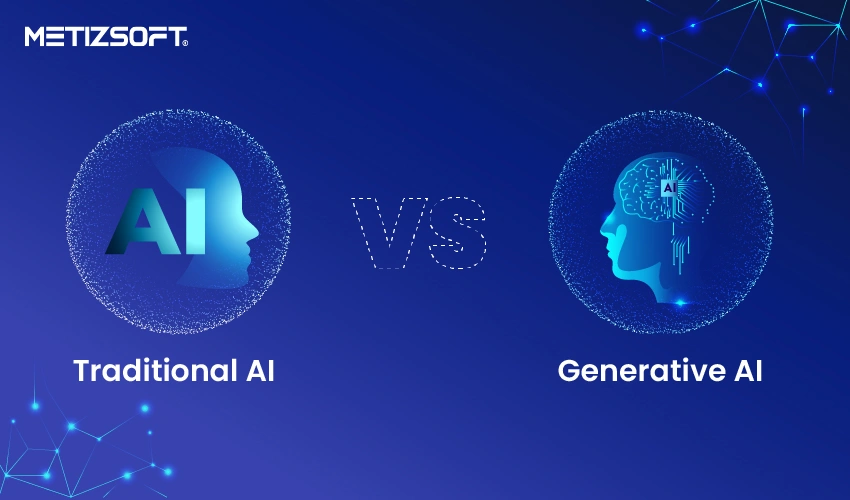
Keep reading this blog, where we have discussed the crucial insights of Traditional AI vs Generative AI. From definition to key differences between Traditional AI and Generative AI for your understanding and clear decision making.
What is Traditional AI?
Traditional AI, popularly known as Narrow or Weak AI, is designed to be smart at one specific thing. It won’t create anything new, but it will do the specific job accurately for which it has been made. Think of it as a system built to respond to a particular set of instructions. These systems can learn from information and use that learning to make decisions or predictions.
For example, when you play computer chess, the computer knows all the rules. It can guess what you might do next and choose its own moves based on strategies it already knows. It’s not coming up with brand-new ways to play; it’s picking from the tactics it was programmed with. That’s traditional AI – a smart problem-solver within clear boundaries.
Other examples of traditional AI include Siri or Alexa (voice assistants. The suggestions Netflix or Amazon give you, or how Google finds search results. These AIs are trained to follow specific rules and do a particular job really well. But they don’t create original ideas or go beyond their programming.
What is Generative AI?
Generative AI, or GenAI, is a subset of artificial intelligence that can create new things. Unlike traditional AI, which mainly responds to specific instructions, generative AI can take the information you give it and produce something original.
For example, you ask the generative AI to write a blog post for you on any current topic. Let’s say “AI role in MVP development”! You just need to find the trending and most searched blog topic on this and write an 800+ word blog using the right keyword with all key points. Generative AI will twist this general piece of information into the perfect blog post, with all key points and subpoints. It will attach real-world examples for you to modify and edit.
What’s interesting is that today’s generative AI isn’t just limited to text. It can also create images, music, and even computer code! These generative AI models learn from huge amounts of existing data and then figure out the patterns in that data. This allows them to generate new data that looks and feels similar to what they were trained on.
Key Differences Between Traditional AI and Generative AI
Applications
- Traditional AI: Traditional AI, on the other hand, is helpful for everyday tasks like looking at data, finding fraud, and suggesting things you might like, such as on shopping websites.
- Generative AI: Generative AI is being used in lots of interesting and creative ways. You’ll find it helps to make digital art, compose music, generate code, and create different kinds of content.
Adaptability
- Traditional AI: Traditional AI is less flexible. It usually sticks to the rules and focuses on improving at a specific task. It’s not really designed to learn and evolve in unexpected ways.
- Generative AI: Generative AI is really good at adapting because it can learn and come up with new things in creative ways. As it learns from more and more information, it can create increasingly impressive content.
Practical Implication
- Traditional AI: The power behind the chatbots we talk to online. The recommendation systems that suggest what to watch or buy, and predictive analytics that help forecast trends.
- Generative AI: It opens up a lot of exciting new possibilities for creativity and generating fresh ideas. For example, in entertainment, it could help make new music, write movie scripts, or even create realistic-looking fake videos (called deepfakes). It could even help write news articles or reports.
Output
- Traditional AI: Traditional AI takes existing information and uses it to give you insights or make predictions. So, the result is usually a label (like classifying an image), a suggestion (like a product recommendation), or a forecast based on what it has learned from past data.
- Generative AI: Generative AI creates new things, giving every creation a futuristic touch. This version of AI can invent and bring fresh content.
Training Data Requirements
- Traditional AI: Traditional AI, on the other hand, can often perform well even with smaller, more focused datasets. It’s more about spotting patterns and making predictions based on the specific data it has been trained on.
- Generative AI: It usually needs a wide range of information to work well. The more varied and bigger the collection of data it learns from, the better it gets at creating unique things.
Performance Metrics
- Traditional AI: We usually measure its performance using standard metrics such as accuracy, precision, and recall. These scores tell us how well the AI can correctly categorize information, predict future events, or spot patterns in the data.
- Generative AI: We often judge its quality by how creative and high-quality its creations are. This means checking what it makes, like images or text, looks real or new and interesting to us humans.
Cost
- Traditional AI: It’s often free or low-cost. It can use existing technology, making it a practical option for many applications. We actually use traditional AI all the time without even realizing it!
For example, Google Assistant is totally free on our phones, but it also provides us with a helpful AI service.
- Generative AI: On the other hand, generative AI usually costs more. This is because it needs powerful computers and a lot of data to learn from. So, it can be a pricier option, especially for companies looking to try out the latest AI technologies.
For example, the premium version of ChatGPT (ChatGPT Plus costs $20 per month. ChatGPT Pro costs $200 monthly, which is quite expensive for most people. However, traditional AI often comes at no cost.
Learning Curve
- Traditional AI: It’s generally easier to get into. The learning process is more gradual, especially if you already know the basics of how algorithms work and how to process data. This makes it more welcoming for beginners.
- Generative AI: Gen AI can be a bit harder to learn at first. It often involves understanding complex concepts like deep learning and neural networks, which can be tough for people just starting out in AI.
Community & Support
- Traditional AI: It has been around longer, so it has a strong, well-established community. There are many resources available, like guides, lessons, and online forums. All these make it easier for people to find help and work together.
- Generative AI: It’s still pretty new, so its community and support are just starting to grow. You’ll see new online discussions and helpful materials pop up as technology advances.
Future Trend
- Traditional AI: Traditional AI is growing at a steady pace. It will likely focus on improving current processes to make decisions based on data more accurate and efficient.
- Generative AI: It has the potential to really change many industries. It opens up exciting ways to create content and interact with technology. Hire AI developers to get going if you have any innovative generative AI ideas!
Traditional AI vs. Generative AI: Final Takeaway
The root and expansion of AI are larger than our imagination. This game-changing technology is evolving rapidly. As we continue to explore its capabilities far and beyond, knowing the differences between traditional AI and generative AI is crucial for innovation. Both AIs have played and continue to play an essential role in shaping our future, offering unique possibilities. So, embracing these advanced technologies will be key for businesses looking to stay ahead of the curve in the evolving digital landscape.
If the world of AI excites you to innovate something new and unique, now is the time to get going. Contact Metizsoft, a leading AI development company, for a clear understanding of AI. Let’s create voice assistants or ChatGPT-like applications!
Discover More About AI
- Agentic AI V/S AI Agent
- Lifecycle of Agentic AI
- Agentic AI in Retail Business
- Agentic AI in the Healthcare Industry