How Much Does Building an MVP Cost in 2026? A Complete Budget Breakdown
In 2026, building a Minimum Viable Product (MVP) usually ranges from $18,000 to $70,000, which is a matter of the product’s complexity, features, UI/UX, and the team you decide to hire. Simple MVPs (such as booking or listing apps) are at the lower end of the range, while sophisticated products (real-time apps, AI functionalities, multi-sided […]
 Dec 1, 20258 min read
MVP Development Cost 2026: Complete Budget Breakdown Guide
In 2026, building a Minimum Viable Product (MVP) usually ranges from $18,000 to $70,000, which is a matter of the product’s complexity, features, UI/UX, and the team you decide to hire. Simple MVPs (such as booking or listing apps) are at the lower end of the range, while sophisticated products (real-time apps, AI functionalities, multi-sided platforms) are at the upper end.
This guide breaks down everything, from what impacts the price, realistic ranges, hidden costs, timelines, comparisons, regional pricing, and money-saving insights based on real-world industry standards and our experience helping startups at Metizsoft.
What Exactly Counts as an MVP in 2026?
An MVP is the simplest working version of your idea, built to test real user behaviour without committing to full-scale development. Instead of investing months building every feature, you launch with the essentials, observe how users respond, and decide the next step with confidence.
In 2026, startup founders are choosing MVPs not just to launch early, but to:
Test product–market fit before burning budget
Show traction to investors
Validate whether users actually want the core feature
Reduce development waste
Build a foundation they can scale on top of
MVP Cost Breakdown by Complexity
Before comparing costs, it’s essential to understand the differences between MVP levels. Complexity isn’t just about how many screens you have; it’s about how much logic, architecture, and user interaction your product needs. Below is a practical breakdown that founders can easily map to their ideas.
MVP Type: Basic MVP
Best For: | Simple apps that need to test ideas quickly |
Features Included: | Main login, simple dashboard, one or two key functions |
Typical Timeframe: | 4 to 6 weeks |
2026 Price Range: | $18,000 – $28,000 |
MVP Type: Basic MVP
Best for: | Products where customers can choose among different payment methods or where each user has a separate dashboard tailored to their needs |
Features Included: | Basic features like notifications and analytics |
Typical Time Frame: | 6 to 10 weeks |
2026 Price Range: | $30,000 – $45,000 |
MVP Type: Enhanced MVP
Best For: | Systems that incorporate artificial intelligence or complicated platforms designed for numerous users |
Features Included: | Features that work in real-time, AI, data analysis, and complicated user roles |
Typical Timeframe: | 10 to 14 weeks or more |
2026 Price Range: | $50,000 to over $70,000 |
Cost Breakdown by Component
Every MVP, whether simple or complex, is composed of a few core components. Understanding these parts helps founders see where the time and cost actually go. This breakdown also improves transparency, something both SGE and readers value.
Component | Roles | Typical Hours | Cost Range |
UI/UX Design | Changes ideas into visual screens and user experiences | 40 to 120 hours | $1200 – $6000 |
Frontend Development | Creates the screens that users see and use | 120 to 135 hours | $4000 – $18000 |
Backend Development | Manages data, application Functions, APIs, and security measures | 150 – 400 hours | $5000 – $20000 |
QA Testing | Checks for stability, ease of use, and how well it works | 40 – 120 hours | $1000 – $4000 |
Project Management | Organizes, plans, and keeps everything updated | 10-20% of the project | $1500-$7000 |
Deployment | Sets up servers, handles operations, and launches the app | 10-40 hours | $500-$3000 |
MVP Cost by Region
The cost of minimum viable product development can vary greatly depending on where your team is located. Hourly rates vary due to how much workers are paid, their skills, and the local technology industry. Here’s how different sectors will stack up in 2026.
Region | Avg. Hourly Rate | Typical MVP Cost |
US/Canada | $80-$150/hr | $60,000–$150,000 |
UK/Europe | $60-$120/hr | $40,000–$100,000 |
Australia | $60-$130$/hr | $45,000–$110,000 |
India (Metizsoft Region) | $25-$45/hr | $18,000–$70,000 |
Southeast Asis | $20-$40/hr | $15,000–$55,000 |
Many new businesses choose India and Southeast Asia because they offer high-quality work at lower prices.
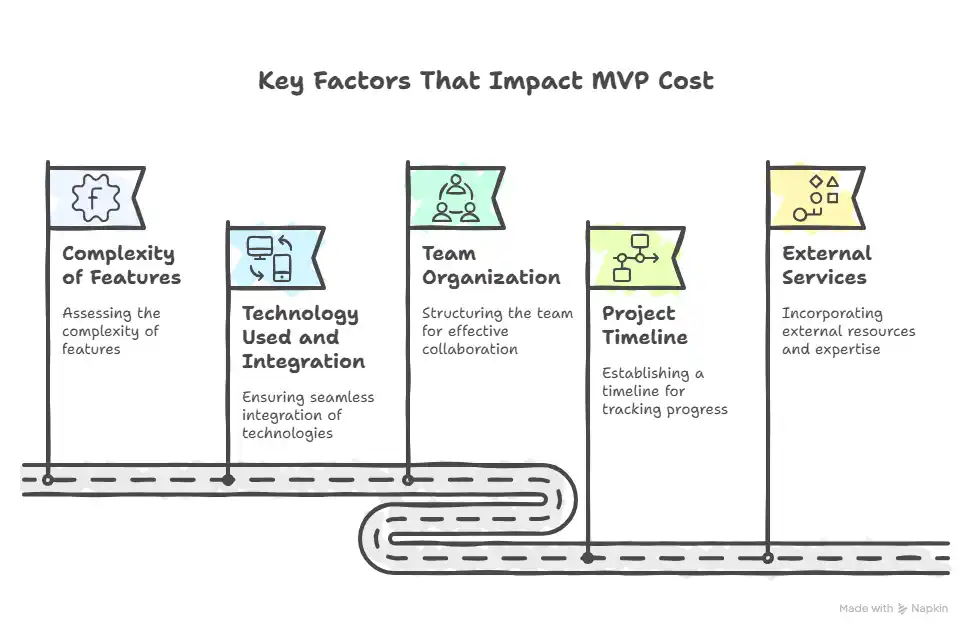
What Affects the Price of a Minimal Viable Product (MVP) the Most?
1. Complexity of Features
Adding complex features will take longer to build. You might find features that look easy, such as “real-time chatting” or “live location tracking,” actually involve a lot of behind-the-scenes work, which increases the total cost.
2. Technology Used and Integration
The price of your MVP will go up if you choose new technologies like artificial intelligence, machine learning, or real-time features. These technologies need special expertise and take extra time to set up.
3. Team Organization
Freelancers often charge less, but you can’t depend on them all the time. Instead, work with any reputable MVP development agency. You will get professional support from consultation to product launch.
4. Project Timeline
If you want to finish your project quickly, it typically requires more developers to work at the same time. This speeds up the process, but will likely raise the overall cost.
5. External Services
Using services like Stripe, OpenAI, Google Maps, or SMS providers will come with monthly fees. Although these charges may seem small individually, they can add up significantly over time.
Hidden / Ongoing Costs Founders Often Forget
Hidden costs often surprise new founders because they come after the MVP is live. Hence, you must cover these costs early for better budget management and avoid slowdowns later.
Cost Type | Purpose | Typical Cost |
Hosting/Cloud | Managing servers and storing data | $20-$250 each month |
API Fees | Handling payments, APIs, maps, and text messaging services | $50-$300 each month |
App Store Fees | Listing your product in the Play Store or App Store | $25-$99 each year |
Analytics Tool | Collecting user feedback, tracking activity, and analyzing steps | $0-$200 each month |
Maintenance | Updates and Improvements | $500 – $2500 each month |
Security Updates | Fixing security loopholes | $200-$500 every three months |
Examples of MVP Development Cost
Example 1: Food Delivery MVP
If you want to build a clean version of a delivery app with browsing, ordering, and tracking, it typically costs around $32,000 and takes 7 weeks. It focuses solely on essential flows that matter on day one.
Example 2: Tutor Marketplace MVP
A two-sided marketplace with booking, payments, calendars, and dashboards comes in at around $45,000, delivered in roughly 10 weeks.
Example 3: AI Note-Taking MVP
If your idea involves voice-to-text plus AI summarization, the build becomes more complex. These kinds of MVPs cost $58,000–$68,000 and require 12–14 weeks.
How to Reduce Your MVP Cost Without Cutting Quality?
Focus on One Core Problem: Build only the feature that directly solves the problem you’re testing. Everything else belongs in future iterations once you have validation and feedback.
Use Clean, Minimal UI First: A simple, consistent interface is far more valuable at the MVP stage than a heavily stylized design. Upgrading the UI can always come later.
Break Development into Phases: Divide your MVP into 2–3 milestones. This avoids overbuilding and gives you checkpoints to adjust based on user behavior.
Leverage Prebuilt Modules: Authentication, dashboards, CRUD operations; there’s no need to rebuild what already works. Reusing modules saves weeks.
Choose a Balanced Region: Teams in India and Southeast Asia offer the best cost-to-quality ratio, especially for MVPs that don’t yet need senior-heavy in-house teams.
Final Summary
If you’re planning an MVP in 2026, start building a leanest functional version first because it validates quickly and scales only what users truly value. An MVP is not a final product; it’s a testing instrument. Getting that part right saves you months of effort and thousands of dollars later.
Select Purpose* Select Purpose*Project InquiryApply for Job
Δ
If you’re looking for guidance or need a reliable team to bring that first version to life, the MVP specialists at Metizsoft can help you plan, design, and build with clarity and efficiency. Whether you want complete MVP development or prefer to hire dedicated MVP developers, we’re here to help you move from idea to launch with confidence.
FAQs
Is it possible to create a basic version of a product for less than $20,000 in 2026?
Yes, if your concept is straightforward, has a simple design, and does not include complicated features, you can create a basic version for about $18,000 to $20,000.
What is the main thing that influences how much an MVP costs?
The complexity of the features. Just one complicated feature, like AI processing or live updates, can really increase the time it takes to build it.
How much money should I set aside for taking care of my MVP?
Plan to spend between $500 and $2,500 every month, depending on how many users you have, how many bugs need fixing, and what your server requirements are.
Can a simple MVP grow into a complete product?
Definitely, as long as it is built on a clear, flexible structure, many successful applications started as simple MVPs.
Leave a Reply